AI SaaS
How Fast Can You Build an AI SaaS MVP in 2027? A Benchmark Report

Nov 13, 20268 min read
#AI SaaS#MVP#Benchmark#AI Agents
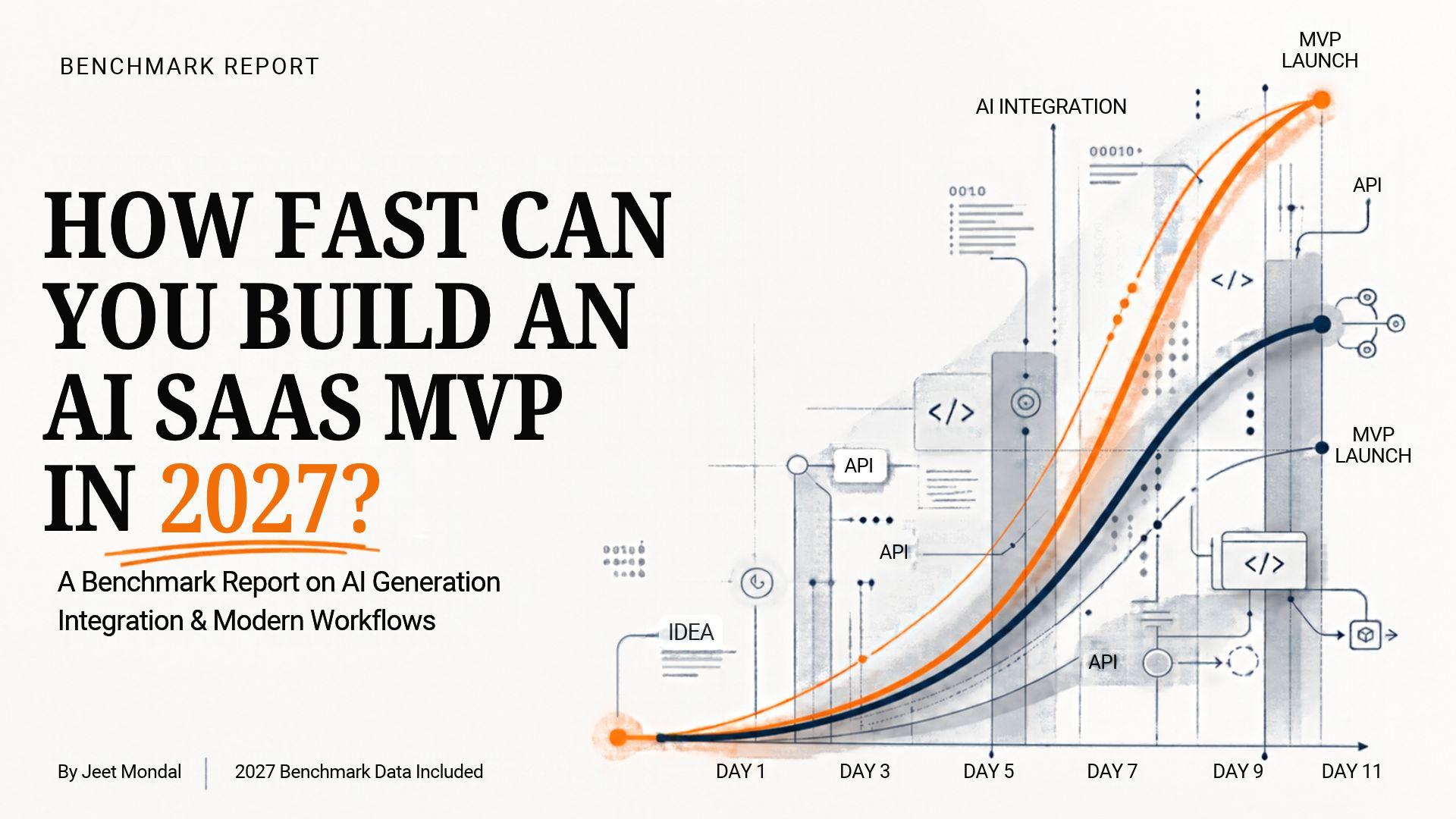
TL;DR: A team of three shipped a production AI product, with auth and billing, in 11 days. The typical AI MVP takes 8 to 12 weeks. The speed wasn't magic. It came from two disciplines: don't hand-build what you can rent, and don't let the AI see what it doesn't need to see.
We built Darkclown's AI Product Recommendation and Customer Query Handling Agent in 11 days. The team was two builders and one senior lead. Darkclown is live and serving hundreds of thousands of users globally.
Our definition of MVP is strict, so the number holds up: a working core feature, customer authentication, and billing. Not a demo. Not a prototype.
The rest of this report covers where that number sits against the market, why it was possible, and the one engineering decision that decides whether an AI MVP survives its first month.
A 2026 benchmark of 30 software MVP builds found a median of 12 calendar weeks from signed kickoff to first live release, with the fastest at 5 weeks and the slowest at 26. In the same data, B2B SaaS MVPs took 8 to 18 weeks.
AI products tend to run longer:
| Build type | Typical timeline |
|---|---|
| Median software MVP | ~12 weeks |
| AI MVP (AI-first team) | 8-12 weeks |
| AI MVP (traditional team) | 16-20 weeks |
| Darkclown AI agent (core + auth + billing) | 11 days (~1.5 weeks) |
Note: most published timelines come from agencies, including us. Treat any single vendor's numbers as a range, not a rule.
Giving a team more time doesn't reliably fix AI projects. RAND's analysis of 2,400+ enterprise AI initiatives found roughly 80% fail to deliver their intended business value, about double the failure rate of regular IT projects. MIT's NANDA research reported that 95% of generative-AI pilots fail to deliver measurable P&L impact. Gartner expects over 40% of agentic AI projects to be cancelled by 2027.
Two honest caveats. First, the numbers vary with definitions. One summary reports RAND's total failure rate as 62.2%, and a survey of 756 companies found most say fewer than 40% of their pilots fail to reach production. A fair reading is that somewhere between a majority and nearly all AI pilots underdeliver, depending on how you count. Second, these studies cover enterprise pilots, not startup MVPs. We use them as a signal, not a like-for-like comparison.
What matters is the pattern. One analysis argues that the bottleneck sits outside the model, since failure rates barely moved as models improved. The model usually isn't the problem. The system around it is: the data, the tooling, the scope, and the guardrails.
Scope is the other classic killer. One 2026 breakdown found that each added feature typically costs one to two extra weeks. A team that expands scope mid-build can lose a month without noticing.
The product: The Product Recommendation Engine (visitor uploads a product image or describe his need & the AI finds the matching product). If they change their mind, the AI keeps helping. Customer Query Handling (If they ask about a refund, the AI already knows their context.)
The Goal is Simple: Turn a Visitor into a Paying Customer.
The stack: Python, FastAPI, LangChain, a vector database, mem0 for memory, LangSmith for testing, Clerk for authentication, Dodo Payments for billing, and UI components from 21st.dev. The model is GLM 5.3 flash.
The 11 days (10.5 days of work, rounded up):
| Stage | Time | What happened |
|---|---|---|
| 1. Core feature | 3.5 days | Recommendation engine and query handling: system instructions, knowledge base, and tools |
| 2. Test with dummy data | 1.5 days | Generated test data, ran the agent in LangSmith, and logged every failure. No development during testing, only observation |
| 3. Fix what testing found | 2.5 days | Context handling, memory (mem0), system-level guardrails, and a unique agent ID per agent for audit trails |
| 4. Product integration | 1 day | Connected the engine to the real product UI |
| 5. Final-stage testing | 1 day | Last round of testing and fixes on the core engine |
| 6. Auth and billing | 1 day | Customer authentication (Clerk) and payments (Dodo Payments) |
Notice the shape. Stages 2, 3, and 5, which are testing and fixing, take 5 of the 10.5 days. Fast teams don't skip quality work. They schedule it first and keep it separate from building. Stage 2's rule was strict: no development while testing. Observe, record, then fix in a batch.
This is the decision that separates an MVP that survives from one that quietly bleeds money.
Darkclown has 20,000+ products across many categories. The obvious approach is to hand the AI the whole catalog and ask it to pick. Here's the math:
That's roughly $4,500-15,000 a month before a single customer pays you. And at 10 million tokens, no model can even take it in one call, so you'd be splitting the catalog across many calls.
"But we only have 200 products." You're still in trouble, in a different way. 200 products × 500 tokens is about 100,000 tokens in a single run. The cost is manageable, but the accuracy isn't.
Chroma's research tested 18 LLMs and found performance grows increasingly unreliable as input length grows, even under minimal conditions. The degradation appears well before the context window is full. Earlier research found that models attend well to the start and end of their input but poorly to the middle, and a product list is exactly that shape.
The result is rarely a loud crash. The AI quietly skips the best match, or invents a product that sounds plausible. It doesn't fail loudly. It fails confidently. You only find out when a customer gets the wrong recommendation.
We built a custom filtering engine in Python that the AI calls as a tool. It scores every product on how closely it matches the request, and only products scoring above 70% are shown. Junk is removed before the AI ever sees it. The model reasons over a handful of strong candidates, not 20,000 raw records.
That one decision fixes both failure modes:
A missed step like this one costs more than most founders expect. That's why precision matters as much as speed.
An MVP's job is to reach the market, learn, and improve. Rebuilding solved problems by hand is the fastest way to miss that window.
For Darkclown, we rented everything that wasn't the product's unique value:
Every one of these has a free tier or a low entry cost. We built the one thing no vendor could give us: the product-matching engine that made Darkclown work.
The principle: build first, then improve. Don't over-engineer the MVP. Spend your custom engineering on the parts that make your product different, and use proven tools for the rest.
Before you hire anyone, ask these:
Eleven days is not the new normal for every product. Darkclown had a clear scope, a team that had solved these problems before, and a firm rule against over-building. A product with heavy compliance, custom model training, or many integrations will take longer.
But the gap between 11 days and 12 weeks is too large to be luck. It comes from engineering discipline: scope tightly, filter before you reason, test as its own phase, and rent everything that isn't your edge.
If you're planning an AI product and want to know what's possible, talk to us at Xanatomy (xanatomy.in). We build fast and precisely, our clients build with us, and they scale with us.
Everything you need to know about working with us.
Usually 8 to 12 weeks for an AI-first team and 16 to 20 weeks for a traditional one, according to a 2026 guide. Xanatomy built Darkclown's AI recommendation and customer query agent, with authentication and billing, in 11 days with a team of three.
A working core feature, customer authentication and billing. Not a demo, and not a prototype. That strict definition is what the 11-day figure is measured against.
Cost and accuracy. For 20,000 products at about 500 tokens each, every search sends around 10 million tokens, roughly $150 to $500 a day at 100 searches. Model accuracy also drops as input gets longer, so the AI can skip the best match or invent a product.
With a custom Python filtering engine that the AI calls as a tool. It scores every product against the request and passes on only those scoring above 70%, which cuts the AI's input from millions of tokens to a few thousand.
Everything that isn't your product's unique value. For Darkclown that meant mem0 for memory, LangSmith for testing, Clerk for authentication, Dodo Payments for billing and 21st.dev for UI components. The custom engineering went into the product-matching engine.
Share it with your network

