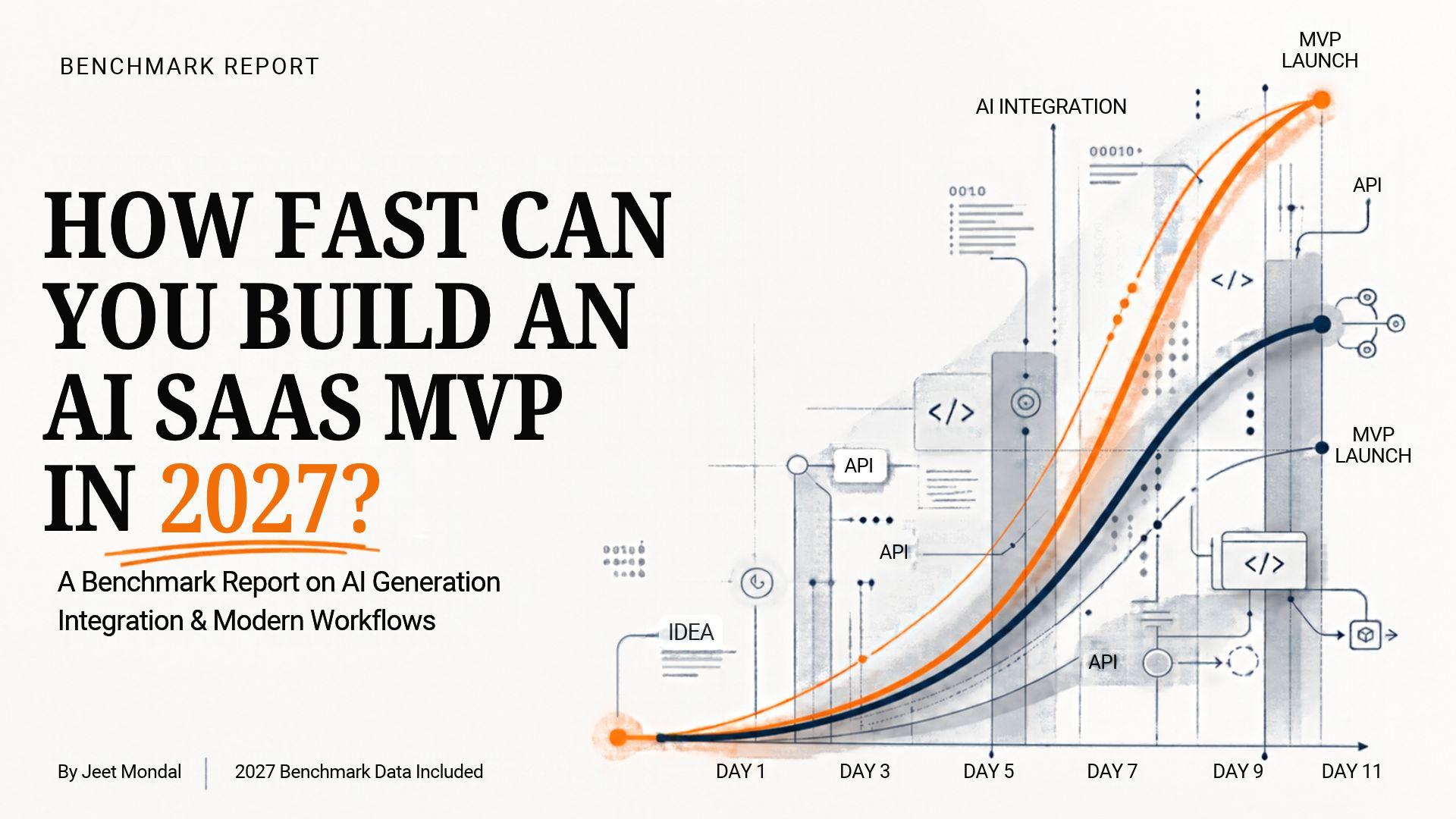
AI SaaS
The 12-Day Micro-Sprint Protocol: How Xanatomy Ships AI SaaS MVPs

Nov 29, 20267 min read
#AI SaaS#MVP#AI Agents#Engineering Process
TL;DR: Most AI SaaS startups waste 8 to 12 weeks building commodity authentication, billing, and fragile multi-agent graphs before testing their core reasoning loop on real data. At Xanatomy, we cap MVP engineering and production launch at a strict 12-working-day ceiling by locking a PRD before Day 1, filtering datasets deterministically before the LLM sees a single token, decoupling black-box stress testing from bug fixing, and renting every non-core infrastructure layer.
When pre-seed and seed technical founders hire a traditional software agency, they usually get handed a three-month roadmap built for deterministic CRUD apps. The agency spends the first six weeks building custom login flows, multi-tenant admin panels, and hand-rolled billing tables. They treat the AI layer as an API wrapper to plug in during week seven.
When they finally wire up the model, three things break immediately:
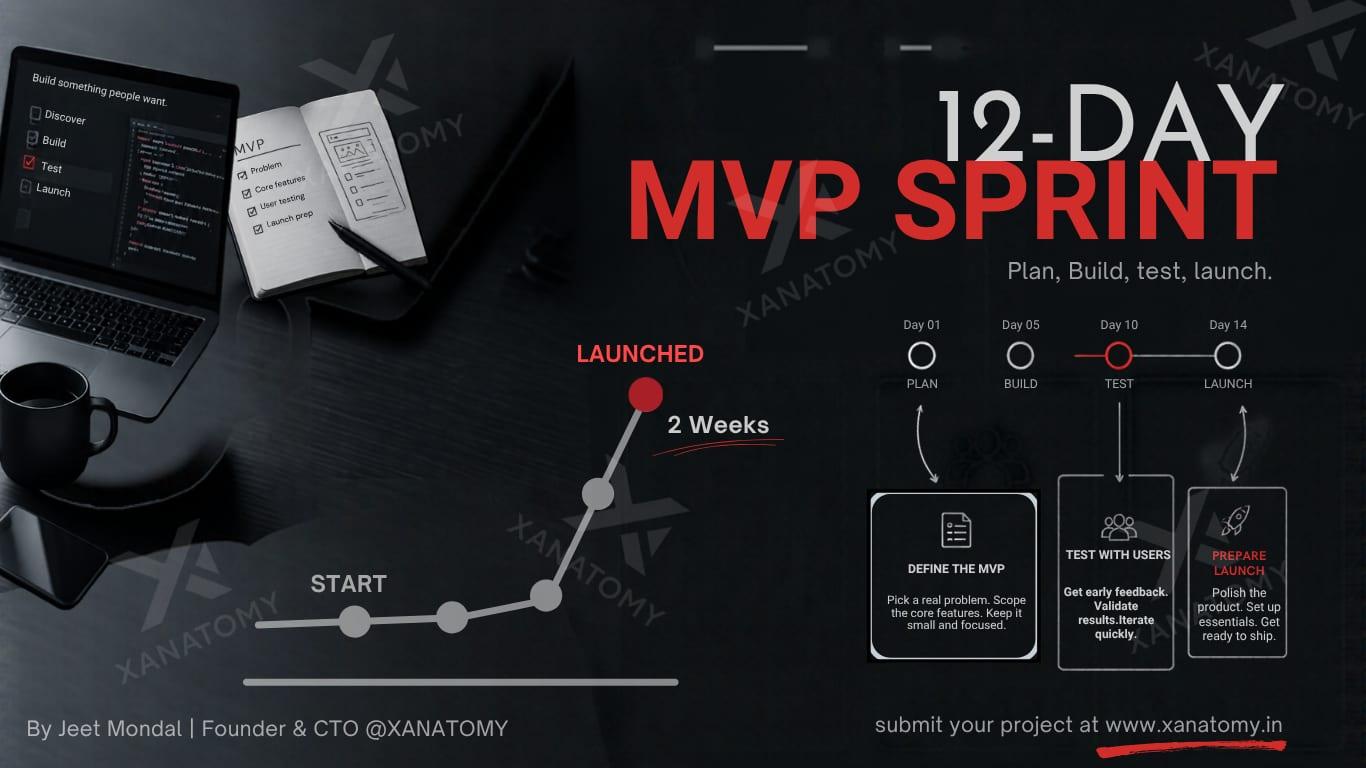
At Xanatomy, we engineered an execution system specifically for stochastic software. 12 working days is our hard ceiling to engineer and launch a production AI SaaS MVP. We shipped Darkclown in 11 days, and we built Beyond BIM Technologies' quoting agent under the exact same protocol—adjusting within that 12-day window to account for differences in domain complexity, founder workflows, and data structures.
We do not start the 12-day clock on vague Notion brainstorms. Before Day 1 begins, the founder and our lead engineer lock a concise Product Requirements Document (PRD).
The PRD enforces three boundaries:
Every Xanatomy build runs through six sequential phases. Notice that half the sprint is dedicated to isolated testing, remediation, and production hardening—not blind coding.
Architecture & pre-filter lock
Days 1–2
Core engine build
Days 3–5
Black-box stress testing
Days 6–7
No code edits
Remediation & guardrails
Days 8–9
Product & UI integration
Day 10
Auth, billing & cutover
Days 11–12
Live
Architecture & pre-filter lock
Days 1–2
Core engine build
Days 3–5
Black-box stress testing
Days 6–7
No code edits
Remediation & guardrails
Days 8–9
Product & UI integration
Day 10
Auth, billing & cutover
Days 11–12
Live
| Phase | Window | Core Deliverable | Non-Negotiable Rule |
|---|---|---|---|
| 1. Architecture & Pre-Filter Lock | Days 1–2 | Deterministic scoring filter + rented stack setup | Zero raw catalog dumps into the LLM |
| 2. Core Engine Build | Days 3–5 | Single-agent reasoning loop, tool schemas & memory | No frontend work; test via CLI and API |
| 3. Black-Box Stress Testing | Days 6–7 | Synthetic adversarial runs traced in LangSmith | Zero code or prompt edits during testing |
| 4. Batch Remediation & Guardrails | Days 8–9 | Root-cause fixes, guardrails & per-agent audit IDs | Fix failure classes in batches, never one-offs |
| 5. Product & UI Integration | Day 10 | Customer-facing interface wired to the hardened API | Assemble UI primitives; skip custom design systems |
| 6. Auth, Billing & Cutover | Days 11–12 | Login, payment webhooks, rate limits & live deploy | Live by the end of Day 12 |
Before writing agent prompts, we solve context economics.
Consider Darkclown, a visual product-discovery platform with 20,000+ SKUs across multiple categories. If you pass 20,000 products (~500 tokens each) into an LLM, a single search burns 10 million input tokens. At just 100 searches a day, that costs $150–$500/day before a single customer converts—and the model still misses the right item.
CONTEXT DUMP
The whole catalog goes into every prompt.
20,000
products in the catalog
10M
input tokens per search
$150–500
a day at 100 searches, with accuracy lost in the middle
FILTER FIRST
A Python scoring filter runs before the model sees anything.
20,000
products in the catalog
70%
relevance threshold; everything below is discarded
5
strong candidates reach the model
~2.5k
input tokens per search
Instead, we build a deterministic pre-filter in Python first. In Darkclown, our custom scoring layer evaluates metadata and attributes mathematically, discarding anything below a 70% relevance threshold before the LLM ever runs. The model reasons over a handful of high-signal candidates instead of 20,000 raw records—slashing token costs by orders of magnitude while boosting recommendation accuracy.
For 72 hours, nobody touches CSS. Using Python and FastAPI, we build the core reasoning engine around one disciplined, tool-calling agent—never a multi-agent swarm.
Xanatomy Engineering Rule — Skip Multi-Agent Swarms on Day 1: Multi-agent orchestration adds network hops, state-synchronization bugs, and non-deterministic loops. A single well-scoped agent with strict JSON tool schemas, clean retrieval, and persistent memory (mem0) outperforms a five-agent swarm on speed, cost, and reliability for every v1 product.
Whether we are building visual retail matching for Darkclown or custom quoting from past client data for Beyond BIM Technologies, Days 3–5 focus exclusively on:
Fast engineering teams do not skip quality assurance—they isolate it. Across Days 6 and 7, we generate messy, adversarial test inputs (ambiguous requests, mid-session pivots, edge-case file formats, and out-of-scope prompts) and execute hundreds of runs inside LangSmith.
The strict rule of Phase 3: Engineers are banned from editing code or prompts while testing runs. If you patch a prompt mid-test, you pollute your baseline and hide systemic flaws. We only observe, trace, and categorize every failure mode.
With two days of clean telemetry, we spend Days 8–9 eliminating root-cause failure patterns in batches:
Once the backend passes stress testing, we connect the engine to the customer-facing frontend. Instead of burning three weeks translating custom Figma files into bespoke CSS, we assemble clean, high-converting interfaces using modular UI primitives (21st.dev and Tailwind) tailored directly to the core workflow.
An MVP is only real when users can log in, pay, and hit rate-limited production endpoints. In the final 48 hours, we wire authentication, configure subscription or usage-based payment webhooks, enforce token-margin rate limits, and deploy live.
You cannot ship a production AI SaaS in 12 working days if you write authentication or billing from scratch. Our rule is simple: custom-build the proprietary AI engine that defines your valuation, and rent everything else.
BUILT BY XANATOMY
Your IP
RENTED
| Layer | Xanatomy Standard | Why We Rent (Instead of Building) |
|---|---|---|
| Core AI Engine | Custom Python + FastAPI | Your proprietary IP—pre-filters, domain logic, and tool execution. |
| Memory & State | mem0 | Instant cross-session user context without maintaining custom state tables. |
| Tracing & Evals | LangSmith | Full latency, token, and failure-trace visibility from Day 6 onward. |
| Authentication | Clerk | Production SSO, session management, and user auth wired in hours. |
| Payments & Billing | Dodo Payments | Global checkout, subscriptions, and webhooks ready before launch. |
| Frontend Primitives | 21st.dev | Clean, production-grade React components without design-system bloat. |
Darkclown (Shipped in 11 Days): An AI shopping assistant where visitors upload a product image, pivot preferences mid-chat, and get context-aware refund or catalog answers across 20,000+ products. By combining a 70% Python pre-filter, mem0 memory, Clerk auth, and Dodo Payments, we took the entire system from spec to live checkout in 11 days.
Beyond BIM Technologies (Shipped Under the 12-Day Protocol): An AI agent trained on Beyond BIM's past client data that gives each prospect a custom quote for the service they want, and hands the conversation to a human when needed. Applying the same PRD-first lock, deterministic filtering, and isolated LangSmith stress-testing phases allowed us to ship it within our 12-day ceiling without bloated agency overhead.
If you are a technical founder with a clear PRD—or a product idea ready to be locked into one—stop losing months to traditional dev cycles.
Submit your project on xanatomy.in to scope your 12-day micro-sprint.
Everything you need to know about working with us.
12 working days at most. A PRD is locked before Day 1, then six phases run in order: architecture and pre-filter lock, core engine build, black-box stress testing, batch remediation, UI integration, and auth, billing and launch. Darkclown shipped in 11 days.
A short Product Requirements Document that the founder and Xanatomy's lead engineer agree before the sprint starts. It fixes one core loop, the exact data and tool contracts, and a parking lot where every extra feature waits for v1.1.
Multi-agent setups add network hops, state-synchronization bugs and non-deterministic loops. A single well-scoped agent with strict JSON tool schemas, clean retrieval and persistent memory is faster, cheaper and more reliable for a v1 product.
Patching a prompt mid-test pollutes the baseline and hides systemic flaws. During Days 6 and 7, engineers only observe, trace and categorize failures in LangSmith, then fix them in batches on Days 8 and 9.
Xanatomy custom-builds the proprietary AI engine: the pre-filter, domain logic and tool execution. It rents memory (mem0), tracing and evals (LangSmith), authentication (Clerk), payments (Dodo Payments) and UI components (21st.dev).
Share it with your network